
ASPIRE: A SPectroscopic survey of biased halos In the Reionization Era (ASPIRE): A Quasar Legacy Redshift Survey
ALMA Large Program | 2022.1.01077.L | Cycle 9
PI: Feige Wang (University of Michigan)
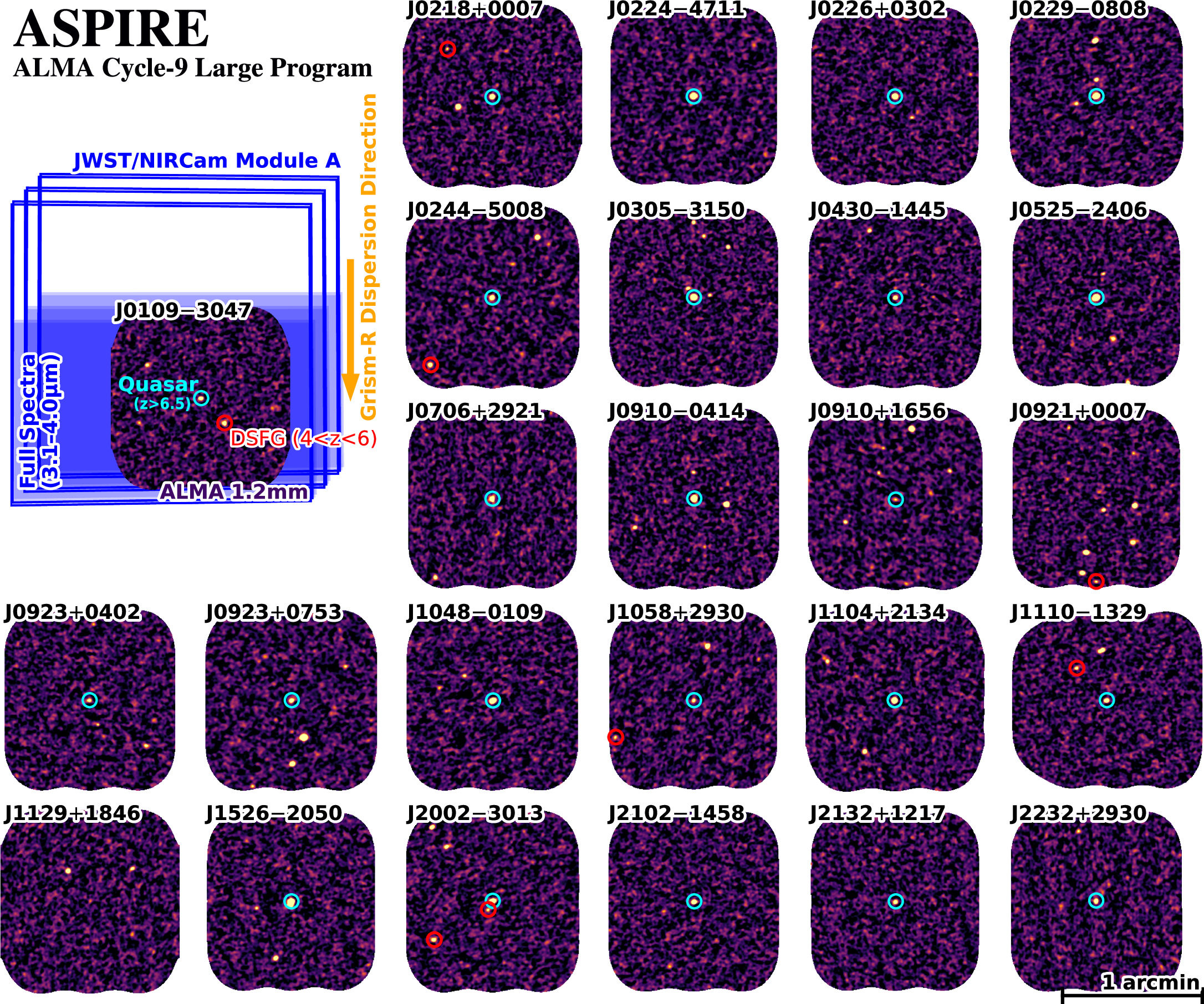
Figure 1. The 1.2 mm continuum images of 25 quasar fields obtained by the ASPIRE–ALMA Cycle-9 large program (Sun et al. 2025).
1. Program Abstract
The ALMA ASPIRE Large Program aims to study the host galaxies, large-scale environments, and dark matter halos of the most distant quasars. ASPIRE targets the 25 most luminous quasars at z~7 using deep ALMA 1.2 mm mosaic observations. These quasar fields are also covered by multi-band JWST imaging and 3-4 um slitless spectroscopy to identify star-forming galaxies at 1<z<7. The ALMA observations detect dust and gas emission from these UV-bright galaxies, uncover faint dusty continuum sources, and reveal new [C II] emitters at the quasar redshifts. This enables us to measure the Mpc-scale clustering of [C II] emitters around distant quasars and ultimately determine whether the earliest supermassive black holes reside in the most massive dark matter halos.
Combined with the extensive multi-wavelength observations already in hand, the ASPIRE team investigates black hole fueling mechanisms across multiple scales and phases, assesses whether quasar environments are dust-rich, and examines how strong quasar radiation influences galaxy formation across different mass ranges. The program will further construct a ~45 arcmin² redshift survey covered by ALMA, JWST, HST, VLA, Chandra, and ground-based imaging and spectroscopy, enabling a comprehensive study of galaxies and the cosmic star-formation history from z∼7 to z∼1. This survey will also connect the circumgalactic medium to its host galaxies and constrain cosmic reionization by combining quasar absorption spectra with the galaxies along the quasar lines of sight.
2. Project Codes
|
Project Code |
Title |
PI |
|
2022.1.01077.L |
A SPectroscopic survey of biased halos In the |
Feige Wang (University of Michigan) Co-PIs: Jinyi Yang, Bram Venemans, Roberto Decarli,Xiaohui Fan, Banados |
3. Team Members
| Name | Affiliation | Country |
| Feige Wang (PI) | University of Michigan | US |
| Jinyi Yang (co-PI) | University of Michigan | US |
| Bram Venemans (co-PI) | Leiden University | The Netherlands |
| Roberto Decarli (co-PI) | INAF - Osservatorio di Astrofisica e Scienza dello Spazio | Italy |
| Xiaohui Fan (co-PI) | University of Arizona | US |
| Banados Eduardo (co-PI) | Max Planck Institute for Astronomy, Heidelberg | Germany |
| Jaclyn Champagne | University of Arizona | US |
| Eiichi Egami | University of Arizona | US |
| Emanuele Paolo Farina | Gemini Observatory | US |
| Joseph Hennawi | UC Santa Barbara | US |
| Weizhe Liu | University of Arizona | US |
| Chiara Mazzucchelli | Universidad Diego Portales | Chile |
| Romain Meyer | University of Geneva | Switzerland |
| Fengwu Sun | University of Arizona | US |
| Fabian Walter | Max Planck Institute for Astronomy, Heidelberg | Germany |
| Minghao Yue | University of Arizona | US |
4. List of Publications
|
Title |
Lead Author |
Reference |
DOI |
|
|
ASPIRE: The Environments and Dark Matter Halos of Luminous Quasars in the Epoch of Reionization |
Wang, Feige |
This is an ASPIRE key paper for the main science goal of quasar environment, it also contains an overview of the ASPIRE program |
||
|
A SPectroscopic Survey of Biased Halos in the Reionization Era (ASPIRE): Spectroscopically Complete Census of Obscured Cosmic Star Formation Rate Density at z = 4─6 |
Sun, Fengwu |
This is an ASPIRE key paper on studying the obscured cosmic star formation rate desntiy at high redshifts |
||
|
The Identification of Two JWST/NIRCam-Dark Starburst Galaxies at z=6.6 with ALMA |
Sun, Fengwu |
The Identification of Two JWST/NIRCam-Dark Starburst Galaxies at z = 6.6 |
||
|
Disturbed Cold Gas in Galaxy and Structure Formation |
Zou, Siwei |
This is a paper studying the connection between CGM absorbers and ALMA detected galaxies |
5. Main Deliveries
A set of complete and calibrated mosaic data cubes and continuum images are available to the community upon request. The sub-mm continuum source catalog is available in the paper by Sun et al. (2025), the [CII] line emitter catalog is available in Wang et al. (2026), and a more complete ALMA line emitter catalog will be available in Decarli et al. in prep.
6. Links to Other Resources
A more detailed information about the ASPIRE program can be found in the following link:
https://aspire-quasar.github.io/index.html
This webpage provides information about the multi-wavelength dataset we have already collected for the ASPIRE program.